Economics is the study of how we use our scarce resources — like time and money — to achieve our goals. At the core of economics is the idea that “there is no free lunch” because we “can’t have it all.” To obtain more of one thing, we give up the opportunity of getting the next best thing. Scarcity is not just a physical limitation. Scarcity also affects our thinking and feeling.
1. Setting priorities. Scarcity prioritizes our choices and it can make us more effective. For example, the time pressure of a deadline focuses our attention on using what we have most effectively. Distractions are less tempting. When we have little time left, we try to get more out of every moment.
2. Trade-off thinking. Scarcity forces trade-off thinking. We recognize that having one thing means not having something else. Doing one thing means neglecting other things. This explains why we overvalue free stuff (e.g., free pencils, key chains, and FREE shipping). These transactions have no downside.
3. Unfulfilled desires. Restriction on desirable things orients the mind automatically and powerfully toward unfulfilled needs. For example, food grabs the focus of the hungry. We will enjoy our lunch more for being deprived of breakfast. Literally, hunger is the best sauce.
4. Mentally depleted. Poverty taxes cognitive resources and causes self-control failures. When you can afford so little, so many things need to be resisted. And resisting more temptations depletes willpower. This explains why poor people sometimes struggle with self-control. They are short not just on cash but also on willpower.
5. Mental myopia. The context of scarcity makes us myopic (a bias toward here and now). The mind is focused on present scarcity. We overvalue immediate benefits at the expense of future ones. We procrastinate important things, such as medical checkups or exercising. We only attend to urgent things and fail to make small investments, even when the future benefits can be substantial.
6. Scarcity marketing. Scarcity is the feature that increases the perceived value of a product. Many stores strategically create a perception of scarcity to motivate impulse buying. For example, the pricing practice of limiting the number of items per person (e.g., two cans of soup per person) can lead to increased sales. The sign implies that the items are in short supply and shoppers should feel some urgency about stocking up. The fear of missing out can have a powerful effect on shoppers.
Source: Image by vitaliy-m from Pixabay
7. Forbidden fruit. People desire more of what they can’t have. Scarcity functions like an obstacle to goal pursuit, which intensifies the value of the goal. For instance, warning labels on violent television programs, designed to decrease interest, often backfire and increase the number of people who watch the program. Sometimes people want things precisely because they cannot have them: "The grass is always greener on the other side."
8. Playing it cool. The scarcity effect explains why coyness often is considered an attractive attribute. Playing hard to get is a most effective strategy for attracting a partner, especially in the context of long-term love (or the marital) in which a person wishes to be sure of their partner’s commitment. A “hard to get” player likes to appear busy, create intrigue, and keep suitors guessing. As Proust noted, “The best way to make oneself sought after is to be hard to find.”
9. Focus on more meaningful activities. Scarcity can also liberate us. Scarcity contributes to an interesting and meaningful life. When time is limited, goals related to deriving emotional meaning from life are prioritized. Midlife often intensifies the feeling that there is not enough time left in life to waste. We overcome the illusion that we can be anything, do anything, and experience everything. We restructure our lives around the needs that are essential. This means that we accept that there will be many things we won’t do in our lives.
Not for the first time, and probably not for the last, Duke basketball looked like a legitimate national championship contender on Monday in the Blue Devils’ 70-65 win over Florida State. But for Duke to get across the finish line, there’s still one thing that ESPN’s Seth Greenberg wants to see.
Talking at halftime of No. 1 Baylor’s win at Texas, Greenberg pointed out that the Florida State game coming on the heels of Duke’s emotional win over rival North Carolina was, “like a turnaround game in the NCAA Tournament. At the same time, he said Duke had work to do.
“I look at Duke big picture, and this is a hard game to play because Florida State’s hard to play against,” Greenberg said. “But I look at Duke, if they’re going to win a national championship — and that is their goal, that’s the standard — they’ve got to get better in the halfcourt. They’ve got to be able to play through Vernon Carey even when people pressure, get up underneath him, and he’s got to work harder to get the basketball.
“Florida State, I think their upside is greater,” Greenberg said, “but their shot selection needs to improve.”
Duke did get some encouraging news on the halfcourt offense front, with Jordan Goldwire scoring 13 points on 5-of-5 shooting. Goldwire plays strong defense and brings another ball-handler—anything that he brings from a scoring standpoint is seen as a bonus.
But he’s improved this season as an outside shooter; Goldwire came into the Florida State game making 33.3 percent of his 3-pointers, a career-best mark.
“My shot was just feeling good the whole day. I was able to get some work in with Coach [Chris] Carrawell before the game. We knew the type of shots that I was going to get and that [Florida State] might leave me a little bit, so just being ready to shoot, my teammates and the coaching staff have the confidence in me, so it felt good to see the ball go in.”
For his part, Duke coach Mike Krzyzewski was pleased with how the Blue Devils played.
“This has been an incredible 48 hours for our team,” Krzyzewski said. “I got good guys, I got really good kids. We beat a heck of a team tonight after beating a heck of a team in an epic game 48 hours before. I don’t know where they got the energy the whole game to do this, but they did, they listened, they fought. We really played good defense.
“You could tell they will tire you out anyway because they play such good defense and they have depth, but at the end of the first half, you could tell we were tired, rightfully so,” Krzyzewski said. “And in the second half, we were kind of holding our own, but when they went ahead 52-50, instead of waiting for the eight minute [timeout], we were ready to get knocked out and so we called a timeout, Alex (O’Connell) came in and Alex gave us five quick points, and that last 8:29 we were terrific.”
The tricky thing about recessions is that it's hard to know when the next one is going to strike. And sometimes, you'll hear rumblings of a recession when the market is doing extraordinarily well, the logic being that all good things economy-related must, at some point, come to an end.
While recessions are a natural and expected part of our country's economic cycle, the idea of one can be nerve-wracking. Here's what I'm doing to gear up for the next one -- in case it happens sooner than we think.
IMAGE SOURCE: GETTY IMAGES.
1. Padding my emergency fund
I always make a point of having about six months of essential living expenses tucked away in the bank. That way, if my income takes a hit, my home needs repairs, or there's a major issue with my car, I have money to tap without having to resort to debt. To buy myself extra protection in the face of a recession, I've been adding a bit more money to that account just to have a more solid cushion. While I am losing out on the opportunity to invest that extra cash, I have it in a high-yield savings account, so it's not earning nothing. And the peace of mind it's giving me is, frankly, worth a modest amount of missed investment opportunity.
Another thing: By padding my emergency fund, I'm helping ensure that I'll be able to leave my investment portfolio untouched should a downturn ensue. That's important, because you don't actually lose money during a recession until you sell off investments at a loss. If I'm able to leave my current stock positions alone, I won't lose money even if their value drops on paper.
2. Adding a few more dividend stocks to my portfolio
Dividend stocks can help you ride out a recession because they continue paying you even when the market on a whole is in the dumps. And while dividends are not guaranteed, buying stocks with a strong history of paying them means your portfolio is likely to generate quarterly income even when there aren't other gains to be had. You can check out this list of recession-friendly stocks to see if any of them have a place in your portfolio.
3. Setting aside extra cash to buy stocks on the cheap
In addition to boosting my emergency fund, I'm also in the process of scrounging up extra cash to buy up stocks on the cheap if a recession strikes. You'll often hear that it's best to sit back and do nothing when a recession takes hold, but actually, a recession is a great time to buy quality stocks at a lower price than what they'd typically command.
Recessions can be a scary thing if you're not prepared for them. Stock values can tank, jobs can be lost, and home prices can plummet. But if you take steps to make yourself recession-ready, you'll have less to worry about the next time the economy turns for the worse -- whether that happens a few months from now, or a number of years.
Windows 10 users will soon only have one option when it comes to checking Facebook – namely their browser of choice – because the dedicated app for the social media service is being shut down at the end of February.
As spotted by MSPowerUser, a Facebook user received an email from the social network informing them that the Windows app will be discontinued on February 28.
The message reads: “Since you use Facebook for Windows desktop app, we wanted to make sure you’re aware this app will stop working on Friday, February 28, 2020. You can still access all of your friends and favorite Facebook features by logging in through your browser at www.facebook.com.
“For the best experience, make sure you’re using the most current version of our supported browsers including the new Microsoft Edge.”
It’s not a huge surprise that Facebook has decided to shutter the Windows 10 app, given that we’re guessing there weren’t a huge amount of users anyway, and the application wasn’t updated regularly or particularly well-maintained.
Indeed, if you go by the Microsoft Store reviews of the application, the words ‘awful’ and ‘buggy’ crop up a lot, as do complaints about freezing, functions not working, and not being able to log in or even get it going.
We’ve never used it – and we suspect that’s the case for many people – but it seems like the app is pretty shaky for many folks, to say the least.
The demise of the Facebook app means that another big service doesn’t have an application in the Microsoft Store, though, and obviously that isn’t a helpful development for the software giant, or the perception of the store.
Note that there is still a Messenger app for Windows 10, which was recently revamped with a new Electron-based version.
At most martial arts schools, rising to the level of black belt requires a test that can take several hours. At Studio Naga, the black belt test is a 48-hour ordeal with no sleep. Students are running on pure adrenaline by the second night when they are blindfolded in the dark and taken toan unknown location. That's when it's time to fight.
The blindfold is removed, revealing a dark path with a flickering candle at the end. Along the way, attackers jump out from the shadows. The black-belt candidates muster all of their focus, courage and strength to find a way through.
DENVER – After more than 30 years in the books, Denver’s pit bull ban will be a thing of the past, following a decision by city council Monday night to give this controversial breed a chance within city limits.
Denver City Council voted 7-4 to repeal the long-standing ban, replacing the law with what could be best described as a “probation” for the breed. The vote came after more than an hour of public hearing on the issue.
Under the new ordinance, the owner must register with Denver Animal Protection and get their dog a "breed-restricted" license. The owner will also have to provide the name and home address of the dog, plus two emergency contacts, an accurate description of the pit bull and proof that the animal was micro-chipped and had received an up-to-date rabies vaccination.
Other restrictions under the new law include: no more than two pit bulls per household, the owner must notify Denver Animal Protection within eight hours if the dog escapes or bites, and they must also notify the agency within 24 hours if the dog dies or the owner moves to a different address.
If the pit bull shows good behavior after three years, Denver Animal Protection will remove the breed-restricted license and the dog will be given the same license as any other dog within the city.
The new ordinance will take effect 90 days after Denver Mayor Michael Hancock signs it into law.
The cities of Lone Tree, Louisville and Commerce City have bans on pit bulls. The City of Aurora is discussing whether to change its law.
Castle Rock’s Town Council repealed its ban in 2018.
First things first: You would have to be one seriously hardhearted bastard not to love The Thing About Harry, Freeform’s belated gay Valentine (premiering Saturday, Feb. 15, at 8/7c). Its leads — Grey’s Anatomy’s Schmitt, Jake Borelli, and newcomer Niko Terho — have chemistry for days. The script, co-written by director and co-star Peter Paige (Good Trouble), goes down as easily as a box of chocolates. Rare is the bestie/wingwoman who’s as appealing as Britt Baron (GLOW). And the movie’s “Will they or won’t they?” moments are way more loaded than they have any right to be. (Will they or won’t they? Of freaking course they will!)
That said, Harry is a classic romcom for both better and worse. Once smartypants Sam (Borelli, blocks if not miles from Grey’s nebbishy Glasses) is forced to reconnect with his now-out former high-school bully Harry (Terho, wielding his crooked smile like a lethal weapon), there’s little no doubt that these opposites will not only attract but discover that they were never really opposites to begin with. Reinventing the wheel, Harry ain’t. The movie goes on to trot out a whole lotta the genre’s clichés (right down to the tried-and-true “You’ve got an eyelash on your cheek” bit). And it further normalizes the lookism that gave Love, Simon its unpleasant aftertaste.
But to quibble with Harry, when it sticks at least the first of its two landings and left even this hardhearted bastard misty-eyed, feels like the equivalent of saying that if love isn’t perfect, it isn’t worth it. It is worth it. And in an age when the broadcast of a gay couple’s kiss can still somehow be “deemed controversial,” a movie like this isn’t just cute, fun and swoon-inducing, it’s important.
THE TVLINE BOTTOM LINE: Like Sam, you might want to resist Harry. The thing is, you’re not going to be able to. It’s as delightful as it is predictable.
As big endowment funds face mounting pressure to reduce their exposure to the fossil fuel industry, there's one thing making their decision easier: the energy sector's underperformance.
In the last ten years, the S&P energy sector gained just 1% as low oil prices, high operational costs and shifting consumer sentiment set off a wave of selling. In the same time period, the broader market gained 212%.
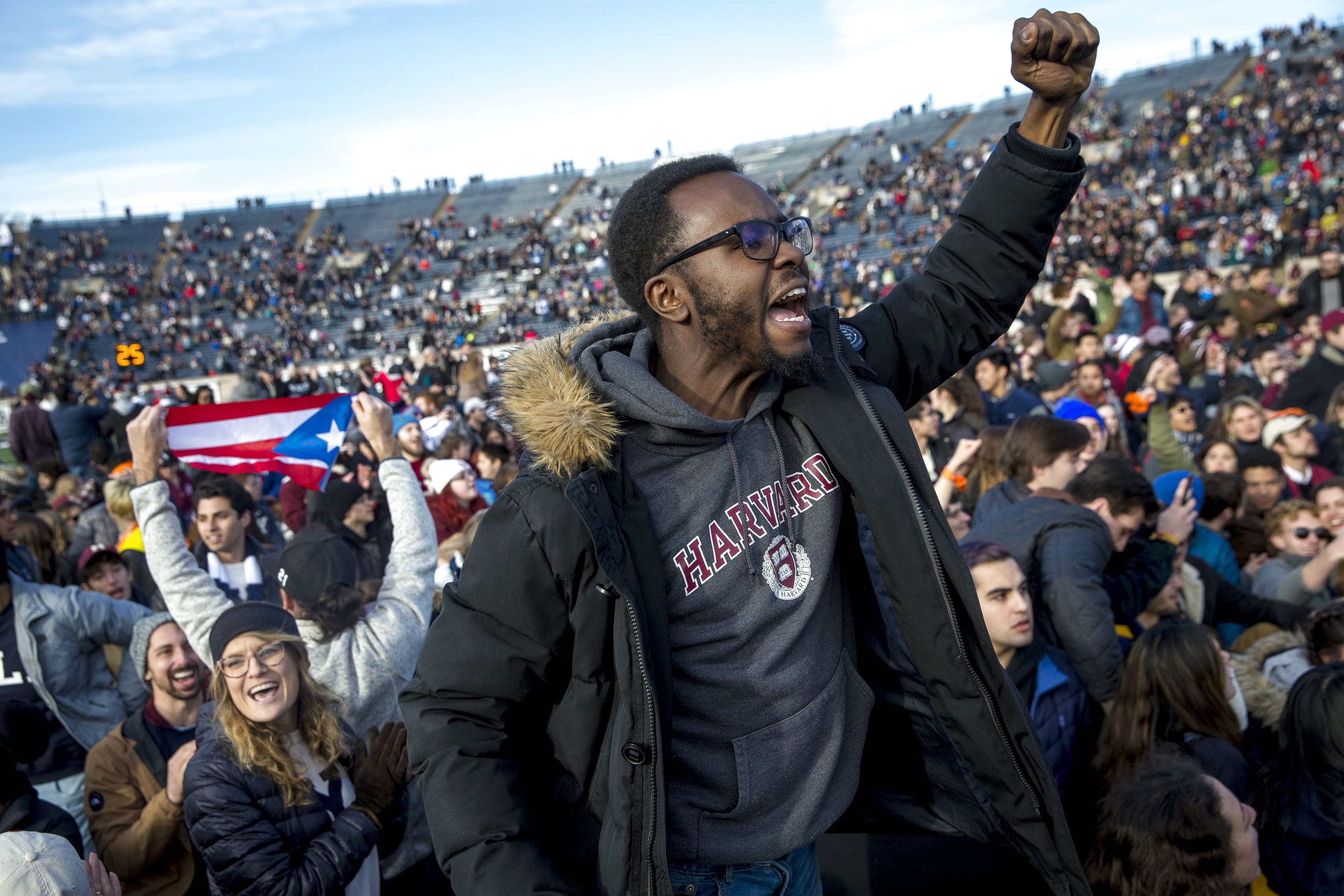
Energy's lackluster performance coincides with college students across the United States protesting university endowments' role in owning and supporting fossil fuel companies. Now, from the perspective of fund managers, divestment could make sense on both financial as well as moral grounds.
"I'm done with fossil fuels ... they're just done. We're starting to see divestment all over the world," Jim Cramer said Jan. 31 on "Squawk Box." "You're seeing divestiture by a lot of different funds ... we're in the death knell phase," he added.
Harvard and Yale students protest during the halftime of the college football game between Harvard and Yale at the Yale Bowl in New Haven, CT on Saturday, Nov. 23, 2019. Demonstrators stormed the field during halftime at the Harvard-Yale football game Saturday, delaying the game for about an hour to demand that both universities divest their investments in fossil fuels and to call attention to the issue of climate change.
Nic Antaya | The Boston Globe | Getty Images
In the course of the last week, two Universities have made key announcements.
On Feb 5. the Harvard Faculty of Arts and Sciences voted in favor of the endowment divesting from the fossil fuel industry in a 179-20 vote, according to the Harvard Crimson. The vote does not ensure implementation. — Harvard President Lawrence Bacow will bring the results before the endowment committee — although the Faculty of Arts and Sciences is the University's largest division.
The vote in and of itself is important since Harvard's endowment is the largest in the world, and is looked at as an example for ways in which other universities can build their own funds. As of June 2019, it stood at $40.9 billion.
One day later, on Feb. 6, Georgetown University announced that it would make no new investments in companies whose business is fossil fuel-dependent, and said over the coming years it would work to shed its exposure to fossil-fuel related companies in both the public and private market.
The actions from Harvard and Georgetown follow the University of California, which in September said it was going fossil fuel free. In an op-ed for The Los Angeles Times the endowment's chief investment officer Jagdeep Singh Bachher and the UC Board of Regents' Investments Committee chairman Richard Sherman said the decision was "not exactly for the reasons you may think."
"Our job is to make money for the University of California, and we're betting we can do that without fossil fuels investments," they wrote on Sept. 17. "We believe hanging on to fossil fuel assets is a financial risk ... While our rationale may not be the moral imperative that many activists embrace, our investment decision-making process leads us to the same result."
"The reason we sold some $150 million in fossil fuel assets from our endowment was the reason we sell other assets: They posed a long-term risk to generating strong returns for UC's diversified portfolios," they added.
Of course, university endowments are complex and composed of many different types of financial instruments, including stocks, bonds, venture capital and private equity investments. So it may be easier said than done to completely divest from the space.
Some argue that since the world will continue to depend on fossil fuels for the foreseeable future, the so-called best actors in the space should be rewarded.
"The focus on divestment is a bit too blunt of an instrument," Valerie Grant, senior vice president at AllianceBernstein, said in November on CNBC's "Power Lunch."
Rather than following a negative screen process — which means completely ignoring one area of the market — she said students should engage with the endowment's investment team to identify long-term risks posed by the climate crisis, and to push for positive changes through shareholder votes, among other things.
"There really has been an evolution in responsible investing ... Traditionally it was all about what not to buy or what not to own. And really I think what most investors are focused on now is what to own," she added.
If you're interested in GGL Resources Corp. (CVE:GGL), then you might want to consider its beta (a measure of share price volatility) in order to understand how the stock could impact your portfolio. Modern finance theory considers volatility to be a measure of risk, and there are two main types of price volatility. First, we have company specific volatility, which is the price gyrations of an individual stock. Holding at least 8 stocks can reduce this kind of risk across a portfolio. The second sort is caused by the natural volatility of markets, overall. For example, certain macroeconomic events will impact (virtually) all stocks on the market.
Some stocks see their prices move in concert with the market. Others tend towards stronger, gentler or unrelated price movements. Beta can be a useful tool to understand how much a stock is influenced by market risk (volatility). However, Warren Buffett said 'volatility is far from synonymous with risk' in his 2014 letter to investors. So, while useful, beta is not the only metric to consider. To use beta as an investor, you must first understand that the overall market has a beta of one. Any stock with a beta of greater than one is considered more volatile than the market, while those with a beta below one are either less volatile or poorly correlated with the market.
Looking at the last five years, GGL Resources has a beta of 1.14. The fact that this is well above 1 indicates that its share price movements have shown sensitivity to overall market volatility. Based on this history, investors should be aware that GGL Resources are likely to rise strongly in times of greed, but sell off in times of fear. Share price volatility is well worth considering, but most long term investors consider the history of revenue and earnings growth to be more important. Take a look at how GGL Resources fares in that regard, below.
GGL Resources is a rather small company. It has a market capitalisation of CA$2.2m, which means it is probably under the radar of most investors. It has a relatively high beta, suggesting it is fairly actively traded for a company of its size. Because it takes less capital to move the share price of a small company like this, when a stock this size is actively traded it is quite often more sensitive to market volatility than similar large companies.
What this means for you:
Beta only tells us that the GGL Resources share price is sensitive to broader market movements. This could indicate that it is a high growth company, or is heavily influenced by sentiment because it is speculative. Alternatively, it could have operating leverage in its business model. Ultimately, beta is an interesting metric, but there's plenty more to learn. In order to fully understand whether GGL is a good investment for you, we also need to consider important company-specific fundamentals such as GGL Resources’s financial health and performance track record. I highly recommend you dive deeper by considering the following:
Past Track Record: Has GGL been consistently performing well irrespective of the ups and downs in the market? Go into more detail in the past performance analysis and take a look at the free visual representations of GGL's historicals for more clarity.
Other High-Performing Stocks: Are there other stocks that provide better prospects with proven track records? Explore our free list of these great stocks here.
If you spot an error that warrants correction, please contact the editor at editorial-team@simplywallst.com. This article by Simply Wall St is general in nature. It does not constitute a recommendation to buy or sell any stock, and does not take account of your objectives, or your financial situation. Simply Wall St has no position in the stocks mentioned.
We aim to bring you long-term focused research analysis driven by fundamental data. Note that our analysis may not factor in the latest price-sensitive company announcements or qualitative material. Thank you for reading.
When spring training kicked off a year ago, Bryce Harper and Manny Machado remained unsigned. The drama this year will center around the Houston Astros: their cheating scandal, reactions from other players about the Astros' cheating scandal, the possibility of other teams throwing at Astros hitters in spring training, the counter-reaction from Astros pitchers and the reaction to the counter-reaction. Fun times!
As pitchers and catchers report, let's look at one major spring training story or player to watch for each team, along with the level of enthusiasm (graded 0-5) for the club entering the season.
Atlanta Braves: What happens at third base? The Braves signed Cole Hamels, Marcell Ozuna and Travis d'Arnaud as free agents, but wouldn't dig deep to bring back Josh Donaldson. Austin Riley and Johan Camargo will compete for the job at third. Riley hit .324 with nine home runs in his first 18 games as a rookie, but pitchers exposed his aggressive approach after that and he hit .192 with nine home runs over his final 203 at-bats. Camargo played well in 2018 with 3.7 WAR, but he struggled in a bench role last season (minus-0.7 WAR). There could be a platoon here with the right-handed Riley and switch-hitting Camargo.
Level of excitement: 5. Coming off two straight division titles and a 97-win season, the Braves feel like this is their best team since Greg Maddux was in the rotation and John Smoltz was closing in 2003. With Ronald Acuna Jr., Freddie Freeman and Ozzie Albies, the fans have a compelling core to root for. Now the Braves just need to snap a string of eight straight losses in the division series.
Miami Marlins: Jorge Alfaro, Isan Diaz and Lewis Brinson. The Marlins brought in some veterans -- Jonathan Villar, Corey Dickerson, Jesus Aguilar -- to help provide support to what was a historically awful offense. The key for the future, however, is the development of the younger hitters. These three all struggled mightily with controlling the strike zone a year ago -- Diaz and Brinson both hit .173 -- and spring training will give some early insight into whether they're showing any improvement.
Level of excitement: 1. Things should get a lot more interesting in 2021, when top prospects like Sixto Sanchez, JJ Bleday, Jesus Sanchez and Jazz Chisholm should reach the majors.
New York Mets: Edwin Diaz, Dellin Betances and Jeurys Familia. Yes, all eyes will be on new manager Luis Rojas, who moved up from quality control coach to manager after previous new skipper Carlos Beltran was let go in the wake of the Astros scandal. More interesting, however, will be the early signs on what the Mets hope will be one of the best bullpens in the majors -- after having one of the worst in 2019. In 2018, Diaz, Betances and Familia combined to pitch 212 innings with 322 strikeouts and a 2.58 ERA. The Mets traded for Diaz and signed Familia, and both were terrible last season. Betances threw just two-thirds of an inning for the Yankees last year and has to come back from a partial tear of his left Achilles tendon, after missing time earlier in 2019 with shoulder and lat injuries. If those three regain their form alongside Seth Lugo, watch out.
Level of excitement: 4. Mets fans, as always, are an emotional blend of relentless pessimism and rabid enthusiasm. This is a fun team, with a powerful lineup led by Pete Alonso and super-ace Jacob deGrom to head the rotation.
Philadelphia Phillies: Joe Girardi. The Phillies signed Zack Wheeler and Didi Gregorius, but the most intriguing move was bringing in Girardi to replace Gabe Kapler as manager. The criticism of Girardi in his final year or two with the Yankees was that he had tuned out and wasn't completely engaged with his players. We'll see if two years away from managing will change that and if he can help figure out -- along with new pitching coach Bryan Price -- how to get a Phillies team that many believe underachieved last year into the 2020 pennant race.
Level of excitement: 3. Phillies attendance increased from 2.16 million in 2018 to 2.73 million in 2019 after the additions of Bryce Harper, J.T. Realmuto and Andrew McCutchen. The only way to get a similar increase in 2020 is to win a lot more than 81 games.
Washington Nationals: How does the infield sort itself out? The key player to watch is rookie Carter Kieboom, MLB.com's No. 21 prospect after hitting .303/.409/.493 at Triple-A. A shortstop in the minors, he struggled at the plate and in the field during his brief MLB stint in 2019, but will get the chance to start at third base or second. Otherwise, it will be a revolving door of veterans: Asdrubal Cabrera, Starlin Castro and Howie Kendrick in the mix at second and third, and Kendrick, Eric Thames and Ryan Zimmerman at first. You can't replace Rendon, but it's the most depth the Nationals have ever had.
Chicago Cubs: Will Kris Bryant be traded? Bryant lost his grievance on service time, so the Cubs now control his rights for two more seasons instead of one. That obviously increases his trade value, but it may also mean the Cubs end up keeping him for 2020. While the Cubs are coming off a disappointing season with 84 wins, remember that they were just two games out of first place until that nine-game losing streak in late September. They underperformed their Pythagorean record by seven wins -- a 19-27 record in one-run games and 4-9 record in extra-inning games didn't help. There's talent here, but trading Bryant would be a loud signal that the Cubs have other interests than trying to win in 2020.
Level of excitement: 3. Trading Bryant will create an even bigger groan of disgust from Cubs fans, who after four straight great seasons (2015 to 2018) now expect greatness every season.
Cincinnati Reds: Who plays center field? It has been a big offseason for the Reds, but the most interesting thing to watch in spring training will be the battle for center field between Nick Senzel and Shogo Akiyama. Senzel moved from the infield to center as a rookie and hit .256/.315/.427, below expectations, and was average -- at best -- in center. He also ended the season on the injured list after a partial tear in his labrum that required surgery. Akiyama, meanwhile, played center field in Japan, but he'll be 32 in April, old for a center fielder, and some scouts are skeptical he has the range to still play there. Reds president of baseball operations Dick Williams said Senzel is not a temporary option at third base (Eugenio Suarez will miss the start of the season) or shortstop, so he'll have to prove himself in center.
Level of excitement: 5. Coming off six straight losing seasons, the Reds have made the push for 2020, adding Akiyama, Nick Castellanos, Mike Moustakas, Wade Miley and Pedro Strop (plus a full season of Trevor Bauer). The most moves do not guarantee success, but the NL Central looks winnable.
Milwaukee Brewers: How does the starting rotation unfold? You don't see this too often: The Brewers made the playoffs and then traded away the two pitchers who started the most games for them (Zach Davies and Chase Anderson). The one rotation lock is Brandon Woodruff, who had a breakout season interrupted by an oblique injury in August. Two to watch closely are Josh Lindblom and Corbin Burnes. Lindblom last pitched in the majors in 2017, but he remade himself as a starter in Korea the past three seasons. Burnes was a top prospect as a starter after a big year in the minors in 2017 and pitched well in relief in 2018, but had a disastrous 2019 with an 8.82 ERA in 49 innings (although he did manage to strike out 70 batters).
Level of excitement: 4. Replacing Yasmani Grandal and Mike Moustakas won't be easy, but the Brewers have made a lot of secondary-type moves. Oh, and having Christian Yelich to anchor the lineup means a third straight postseason trip is possible.
Pittsburgh Pirates: Who are Trevor Williams and Mitch Keller? Well, we know who they are, but the question is how good are they? Williams won 14 games in 2018 with a 3.11 ERA, including an amazing run in which he had a 1.29 ERA over his final 13 starts. He couldn't replicate that success in 2019 (5.38 ERA). Keller was a hotshot prospect who got blitzed in his first MLB test, with a 7.13 ERA and 72 hits allowed in 48 innings over 11 starts.
Level of excitement: 0. No fan base is more disillusioned with its ownership than Pirates fans. Attendance has plummeted by a million since 2015. I doubt it will increase in 2020.
St. Louis Cardinals: Carlos Martinez. Two issues regarding Martinez. He underwent a platelet-rich plasma injection on his right shoulder after the season, considered a minor procedure, and he should be ready for a normal spring training. Still, keep an eye on his health. The other issue is whether the Cardinals will return him to the rotation. He was very good in that role from 2015 to 2017 with 42 wins and a 3.24 ERA before splitting duties in 2018 and making all 48 appearances in relief in 2019. The Cardinals did sign Korean lefty Kwang-Hyun Kim to compete for the rotation, but Martinez arguably has the most upside of any starter besides Jack Flaherty.
Level of excitement: 4. Cardinals fans aren't happy about the club failing to bring in a big hitter to help what was a mediocre offense in 2019; Arenado certainly felt like a potential fit. Still, they're coming off a division title and will draw three million fans for the 17th consecutive season.
NL West
Arizona Diamondbacks: Madison Bumgarner in black, teal and Sedona red. It will look weird seeing Bumgarner in a different uniform, but there are also legitimate concerns about how good he'll be away from the pitcher-friendly confines of San Francisco. We won't learn anything about that in March, and the Cactus League is notoriously hitter-friendly anyway. We'll also start to see what kind of positive influence he may have on guys like Robbie Ray and Zac Gallen, who give the Arizona rotation a lot of upside.
Level of excitement: 4. The only thing holding this down is the Dodgers seem virtually unbeatable in the NL West, but this is an exciting team with rotation depth, good defense and a breakout star last year in Ketel Marte.
Colorado Rockies: Will Nolan Arenado be traded? This seems much less likely now than it did a few weeks ago, but when Arenado shows up and meets the media for the first time, he'll be asked: Do you want to stay in Colorado? He'll almost certainly say "yes," and that he's fully committed to helping the Rockies win in 2020 ... but what if he says no?
Level of excitement: 3. Rockies ownership is talking like 2019 was just a fluky bad season after the success of 2017 and 2018. The fans aren't as optimistic.
Los Angeles Dodgers: Julio Urias. Yes, Mookie Mania will be of immense interest, but that will play out more in the regular season. For spring training and beyond, I'm curious to see if the Dodgers finally take their foot off the brake on Urias. He threw 79 innings in 2019, mostly in relief, but minus Hyun-Jin Ryu, Kenta Maeda and Rich Hill, the Dodgers are down 68 starts. They will presumably lean on David Price to help fill that gap, but Urias should be slated for 25 starts or so.
Level of excitement. 5. Let the good times roll once again. At least until October puts the fear in every Dodgers fan.
San Diego Padres: The young pitchers. How does Chris Paddack look after his impressive rookie season? How about Dinelson Lamet, now even further removed from Tommy John surgery? Will MacKenzie Gore show he's ready -- similar to Paddack a year ago -- to make the leap from Double-A to the majors, if not at the beginning of the season, perhaps soon enough? Or Luis Patino, another top pitching prospect with premium stuff? Or young lefty Adrian Morejon? And flame-throwing reliever Andres Munoz? Can I just spend spring training at Padres camp?
Level of excitement: 4. This was a 5 a year ago with the signing of Manny Machado and the pending arrival of Fernando Tatis Jr., but I get the feeling that enthusiasm has cooled a little after the disappointing 70-win season and failure to add a big name after all the rumors that included Betts.
San Francisco Giants: The comeback attempts in the rotation. Let's see, you have Johnny Cueto, who did return last September. Kevin Gausman will try to bounce back from a 5.72 ERA in 2019. Tyler Anderson made 32 starts for the Rockies in 2018, but just five last year after knee surgery (he's not expected to be 100% in spring training). Tyson Ross is a non-roster invite.
Level of excitement: 2. Attendance dropped under three million for the first time since 2009. It's still an old team, with the best prospects at least or a year or two away.
Baltimore Orioles: Adley Rutschman. The No. 1 overall pick is a non-roster invite, and while he might not get a lot of time in big league camp before being reassigned, it will be the first extended look at the player the Orioles hope becomes the face of their franchise. His stats at Oregon State were ridiculous: .411/.575/.751, with 17 home runs in 185 at-bats, 76 walks and 38 strikeouts. He's already polished behind the plate and will be on the fast track to the majors.
Level of excitement: 0. The Orioles lost 108 games, traded their best position player (Jonathan Villar) and their second-best pitcher (Dylan Bundy). So, umm, yeah.
Boston Red Sox: Chris Sale and Nathan Eovaldi. While the Betts/Price trade finally was completed, we're still waiting for a manager to be named. And we're still waiting for the penalties from the investigation into Boston's sign-stealing scandal to be revealed. Once the dust settles, however, the biggest story of the spring will be the health of Sale and Eovaldi. Sale made his final start on Aug. 13. Eovaldi did return to start the down the stretch, but had a 6.21 ERA over those eight starts.
Level of excitement: 3. Red Sox fans are not happy about Betts' departure and the apparent punt on 2020 to save money. The team isn't without hope, however. The lineup should still score plenty of runs, and the fans will still show up.
New York Yankees: Guys returning from injuries. The news that James Paxton is out several months after spinal surgery to remove a cyst is a reminder of the long list of Yankees coming back from injuries: Miguel Andujar (shoulder), Giancarlo Stanton (knee), Luis Severino (shoulder, lat), Luke Voit (abdominal), Mike Tauchman (calf), Aaron Hicks (Tommy John surgery), Jordan Montgomery (Tommy John surgery). Stanton, Severino and Montgomery did return late in the season, but will be closely monitored. Hicks will still be rehabbing and will join Paxton on the IL to begin the season. Andujar is the key guy to watch, as he undoubtedly will get a lot of action at first base.
Level of excitement: 5. Of course, the biggest spotlight -- even in spring training -- will be on Gerrit Cole. World Series or bust, Gerrit. Good luck.
Tampa Bay Rays: Wander Franco. There is SO much that is interesting about the Rays. Where will everyone play? Is Brendan McKay ready to make the leap and give the Rays another front-line starter? Do they have anybody in the bullpen who doesn't throw 97? But we're talking spring training, and if there's one thing you want to watch in spring training, it's the game's No. 1 prospect. The Rays have not announced Franco as a non-roster invite, but you have to think he'll get called up from minor league camp for some Grapefruit League action. Franco finished last year in High-A and while the Rays traditionally advance their players slowly, Franco may force his way into the big leagues later in the season.
Level of excitement: 4. It should be a 5, but I'm not sure Rays fans know how to get that excited (beyond the die-hards). They won 97 games last year and their attendance was lower than it was in 2017.
Toronto Blue Jays: Sophomore sensations. What will Year 2 look like for Vladimir Guerrero Jr., Bo Bichette and Cavan Biggio? The interesting part about their rookie seasons is that Bichette (.930 OPS) and Biggio (.793) both outhit Vladdy Junior (.772). We saw Guerrero's raw power on display at the Home Run Derby, but he ranked in just the 46th percentile in hard-hit rate (percentage of balls hit at 95-plus mph). When he does make contact, it's too often on the ground. His defense remains, umm, a work in progress as well.
Level of excitement: 3. They have the exciting young core to watch and added three-fifths of a new rotation in Hyun-Jin Ryu, Tanner Roark and Chase Anderson. There is surprise potential here if hitters besides Biggio can learn a little more patience. Check the spring stats to see how that's going.
AL Central
Chicago White Sox: Luis Robert and Nick Madrigal. The White Sox signed the multitooled Robert to a six-year deal with two option years, paving the way for him to start the season in the majors after hitting .328 with 32 home runs in the minors. Madrigal, the fourth overall pick in 2018, should be in the majors soon after. Both will see extensive action in the Cactus League.
Level of excitement: 5. With the additions of Robert and Madrigal, plus the free-agent signings of Yasmani Grandal, Edwin Encarnacion, Dallas Keuchel, Gio Gonzalez and Steve Cishek, and the hopeful return of hard-throwing Michael Kopech from Tommy John surgery, enthusiasm is sky high on the South Side for what should be an exciting team.
Cleveland Indians: What happens in the outfield? It seems the Francisco Lindor trade rumors have died down for now after the Dodgers, Reds, Padres and Mets reportedly pursued him over the winter. At the team's recent Tribe Fest, Lindor told reporters, "If they don't think I can stay here because of the money situation, then I won't be here," and later adding, "The front office tries to put a team together to win, not to save money. They're supposed to try to put a team together to win. I'm here to try to win." Now, about the outfield ...
Level of excitement: 3. The Indians have won 94, 102, 91 and 93 games the past four seasons. The Dodgers are the only other team with active streak of four straight 90-win seasons. Still, the Lindor rumors have disillusioned a fan base still upset over last offseason's inactivity.
Detroit Tigers: The minor league pitchers. The Tigers have an even more impressive group than the Royals as Casey Mize and Matt Manning are consensus top-25 overall prospects and Tarik Skubal came out of nowhere to reach Double-A last season -- even outperforming Mize and Manning at that level with 82 strikeouts in 42⅓ innings. All three are in big league camp and could certainly arrive in Detroit at some point in the regular season.
Kansas City Royals: Also the minor league pitchers. The Royals' hope of turning things around in two or three years hinges on the development of the young starters in the minor leagues. Brady Singer, Jackson Kowar, Daniel Lynch and Kris Bubic are all non-roster invites to spring training. Singer and Kowar reached Double-A last year, while Lynch and Bubic topped out at High-A. All four have impact potential.
Level of excitement: 2. The big league club is still a long way away, and a third straight 100-loss season is certainly possible. The Royals have already lost 15,000 fans per game from their 2015 attendance figures. Rebuilding is not easy.
Minnesota Twins: Rotation battles. With the late addition of Josh Donaldson, the lineup is set, and it's impressive, perhaps even more powerful than last year's group that set the single-season home run record. The spring storyline to watch, however, is the rotation. Jose Berrios, Jake Odorizzi, Kenta Maeda and Homer Bailey are locks, but with Michael Pineda suspended for the first 39 games of the season and Rich Hill out until he comes back from elbow surgery, there are still things to be sorted out, with youngsters such as Randy Dobnak, Lewis Thorpe and Sean Poppen in the mix.
Level of excitement: 5. Last year's division series flameout left a bitter taste after such a fun regular season, so give the Twins credit for adding Donaldson and more depth to the rotation. The Twins have one series victory in the wild-card era, the 2002 ALDS over Oakland. It's time to go deeper into the postseason -- and figure out how to beat the Yankees because they've lost 16 straight playoff games ... 13 of them against New York.
AL West
Houston Astros: The fallout. It will be interesting to see how Astros hitters respond to the throng of national media that will descend upon West Palm Beach. Alex Bregman and Jose Altuve didn't exactly apologize when questioned a couple of weeks ago at the team's fan festival. Will that tone strike a different chord now? While AJ Hinch took ownership during his interview on MLB Network for his own failures in stopping the sign-stealing scheme in 2017, will the players do the same? How will they respond to the accusations that they used buzzers in 2019, which Hinch didn't exactly categorically deny? And that's before we even get to the games and how opponents will respond. That first day of spring training is just the beginning of what will be a long season for Houston.
Level of excitement: 4. But not necessarily an unsuccessful one. Even with the loss of Cole, the Astros project as a powerhouse. Indeed, the current projections at FanGraphs forecast the Astros as four wins better than the Yankees. Playing with a chip on their shoulder creates another intriguing motif.
Los Angeles Angels: Shohei Ohtani on the pitcher's mound. It's going to be a fascinating spring for the Angels -- not just the big signing of Rendon, but the other new faces (Jason Castro, Julio Teheran, Dylan Bundy). We'll also get a look at top prospect Jo Adell, although he may start the season in Triple-A given his struggles there in 27 games last season (.264/.321/.355, no home runs and 43 strikeouts in 131 PAs). The Angels plan to bring Ohtani along slowly from Tommy John; he may not join the big league rotation until May. Keep in mind that he has thrown just 77 innings the past three seasons.
Level of excitement: 4. Angels fans wanted Cole. But Rendon is a pretty nice Plan B. Getting 20 starts from Ohtani is a nice wish, but they should consider that a bonus.
Oakland Athletics: Jesus Luzardo, A.J. Puk and Frankie Montas. The A's have a position battle at second base, a rookie catcher in Sean Murphy, and Khris Davis trying to regain his power stroke, but I want to see the three young starting pitchers. Montas is returning from a PED suspension after an All-Star-caliber first half, and Luzardo and Puk are finally ready for their shots in the rotation, which could be one of the best in the majors with the two rookies and full seasons from Montas and Sean Manaea.
Level of excitement: 5. With the cracks potentially showing in the Astros' foundation, the AL West is ripe for the A's to win it. They won 97 games with the four pitchers mentioned above making just 21 starts.
Seattle Mariners: The kids? By that, we really mean outfielders Jarred Kelenic and Julio Rodriguez, who have both cracked top-10 overall prospect lists this year -- the first top-10s for the Mariners since (cough) Jesus Montero in 2012. Before that, you have to go all the way back to Felix Hernandez in 2005. Both are non-roster invites to camp and Kelenic, who ended 2019 in Double-A, has the ability and confidence to reach the majors this year.
Level of excitement: 1. The farm system is fun. The big league roster? Not as fun. Young players like Evan White, J.P. Crawford, Shed Long, Kyle Lewis and Justus Sheffield will at least get the chance to prove themselves, but it projects as a possible 100-loss season.
Texas Rangers: Corey Kluber. Of all the injury returnees, Kluber is right at the top. The Rangers didn't address their offense in the offseason -- although perhaps a Bryant or Arenado trade can still happen -- so they're counting on Kluber, Mike Minor and Lance Lynn to be one of the best 1-2-3 trios in the majors. Kluber's injuries were a broken forearm and an oblique, so nothing with his elbow or shoulder. He did, however, struggle at the start of 2019, so he'll have to re-establish himself as a staff ace.
Level of excitement: 3. The move to the new park will help ramp up enthusiasm, but on paper the Rangers are still a long way behind the Astros and A's. Adding another star bat would help, but so far the front office has shied away from that additional move.





 First things first: You would have to be one seriously hardhearted bastard not to love
 But to quibble with Harry, when it sticks at least the first of its two landings and left even this hardhearted bastard misty-eyed, feels like the equivalent of saying that if love isn’t perfect, it isn’t worth it. It is worth it. And in an age when the broadcast of a gay couple’s kiss can still somehow be
























 Houston Astros: The fallout. It will be interesting to see how Astros hitters respond to the throng of national media that will descend upon West Palm Beach.